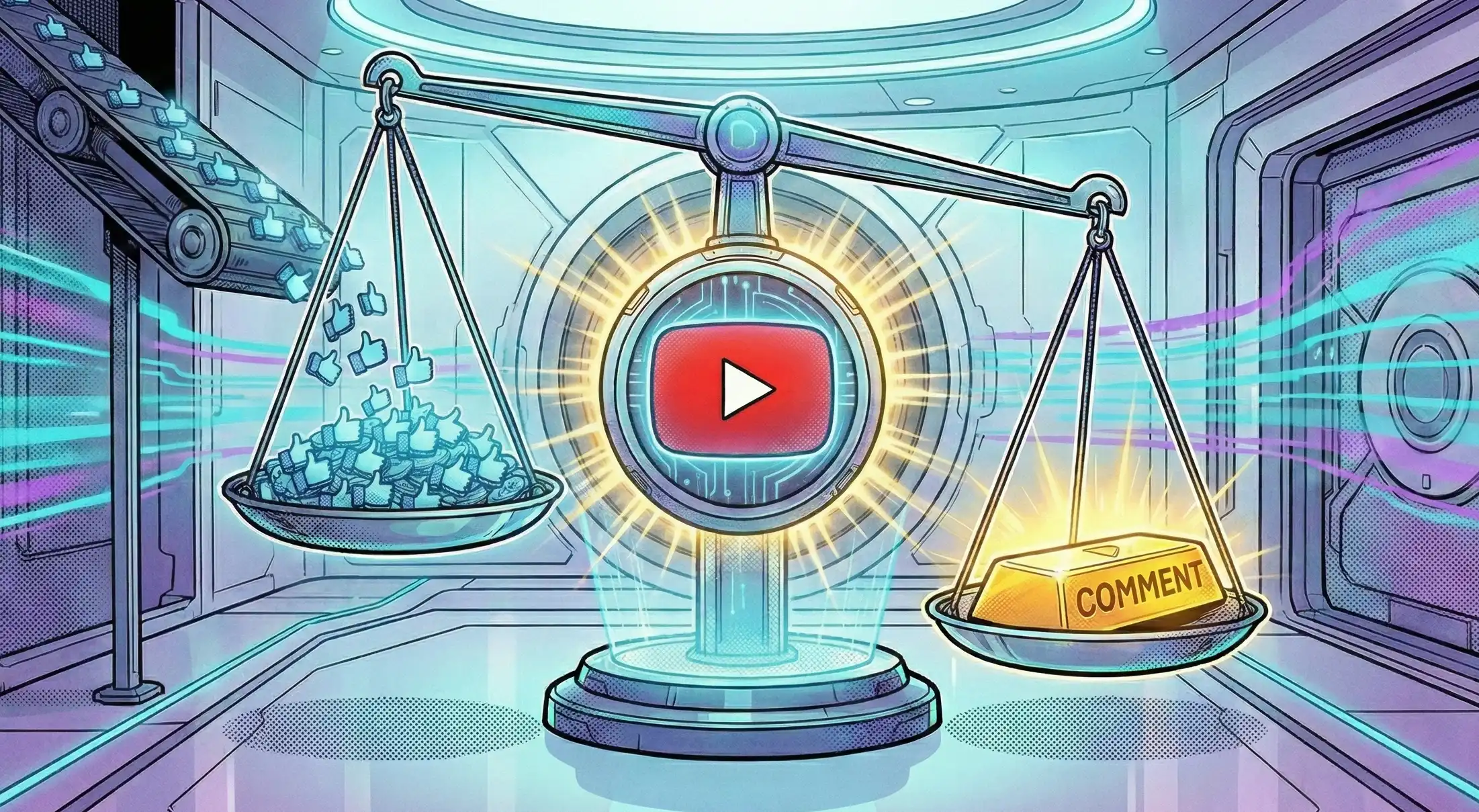
Today, we want to talk to you about engagement. More specifically, the engagement signals that you feed to the YouTube algorithm.
For years, we have seen creators operate under a massive misconception. They treat every single interaction as if it were created equal. Likes, comments and shares, are all counted as if they are all worth the same points on the same scoreboard.
We have worked with hundreds of creators, analyzing the performance of thousands of their videos, and have come to one undeniable conclusion. YouTube does not treat all user interaction the same. YouTube gives differing weights for different types of user interaction.
YouTube considers the like as a low value interaction. Using our previous scoreboard analogy, a like would get you one point. Think about it, what does a like actually cost your viewer? Absolutely nothing. They can double-tap their screen while they are half-asleep, or while they are doom-scrolling on the toilet. It is a reflex, not a decision. To the algorithm, it's a weak signal. It just says, "This was fine."
So what is a high value interaction then? For YouTube, the ultimate high value interaction is the comment. And why is it valuable? Because it requires effort on the part of the viewer to overcome friction. To leave a comment, a viewer has to physically stop the video, formulate a coherent thought, type it out, and hit send. That is effort. To the algorithm, a Comment doesn't just say "this was fine"—it says, "This stopped me in my tracks."
On our scoreboard, a comment would bring us 10 points. A repeated comment from the same viewer? A 100 points.
If you truly want to grow, you need to stop optimizing for low value signals and start engineering high value signals instead.
So what do most creators do? You ask your viewers to "leave a comment" at the end of the video. Perhaps you go a step further and sprinkle multiple requests for comments all across the video. And how effective is this? The comment to view ratio still remains absurdly low.
To force high value interaction, you need to use psychology. You need to use Open Loops.
Try This Out: The Delayed Resolution Strategy
You see, human brains are wired to crave closure. If you open a narrative loop and you don't close it immediately, the brain holds onto that tension. It can't let go.
For years, we have taught creators to weaponize this tension to drive massive comment sections.
Here is how you can implement this yourself:
Start by setting a trap in the middle of your video. Introduce a controversial or specific question. You might say something like, "I actually think this camera is better than the Sony A7. But I know half of you will disagree..."
Now, here is the hook. Don't ask them to comment just yet. Instead, you say, "I'm going to write up my full reasoning and pin it in the comments tomorrow. Check back then to tell me why I'm wrong."
Then, follow through on your promise. Set a reminder on your phone, and exactly 24 hours later, write that detailed comment and pin it to the top.
Why does this work?
Because by delaying the resolution, you aren't just begging for a generic interaction; you are creating an event. You are giving the viewer a specific, compelling reason to return to the video, scroll down, and engage. That sequence, returning and commenting, is the ultimate signal of high value interaction.
The Importance of Execution
We know this strategy builds massive authority. But after having helped hundreds of creators build such open loops and implement a delayed resolution to engineer a spike in high value signals, we also know that this strategy relies heavily on executing perfectly, without fail, repeatedly.
And unfortunately, that's where the problems start for most creators, especially small and mid-sized ones, who don't have an entire team to handle their admin affairs.
The first problem is that creators can get distracted. We have lost count of how many times a creator filmed a perfect Open Loop, promised a pinned comment, and then simply forgot to follow through. The viewer returns, sees nothing, feels cheated, and decides never to engage again.
And if it's not the creator, then it's the viewers that get distracted. Even if they wanted to debate you, they may not have the time right then, so they may close the app and forget you exist five minutes later. The mental itch fades before they ever have a chance to scratch it.
This is one of the core growth problems that HypeKrew was built to solve. HypeKrew lets you close that open loop automatically, without relying on anyone's memory, or having to compete with thousands of things that could distract your viewers.
We designed HypeKrew to handle that nudge for you. Instead of sitting around hoping a viewer remembers to come back, HypeKrew automatically sends a push notification or email to viewers, and we even analyze watch behavior and their local timezone to time this reminder such that it reaches your viewer at a moment when they are statistically most likely to click that link and comment right away.
It takes the cognitive load off both you and your audience. You don't have to remember to pin, and they don't have to remember to return. HypeKrew simply bridges the gap, turning a passive low value viewer into an active high value participant, leaving you free to focus on being at your creative best.
The Bottom Line
Engagement isn't accidental; it is engineered.
If you are just throwing content out there and hoping people talk about it, you are leaving your growth to chance.
To unlock rapid growth, you need to trigger, manage and guide conversations around your video. Passive views just build vanity numbers. Active discussions are what build empires.