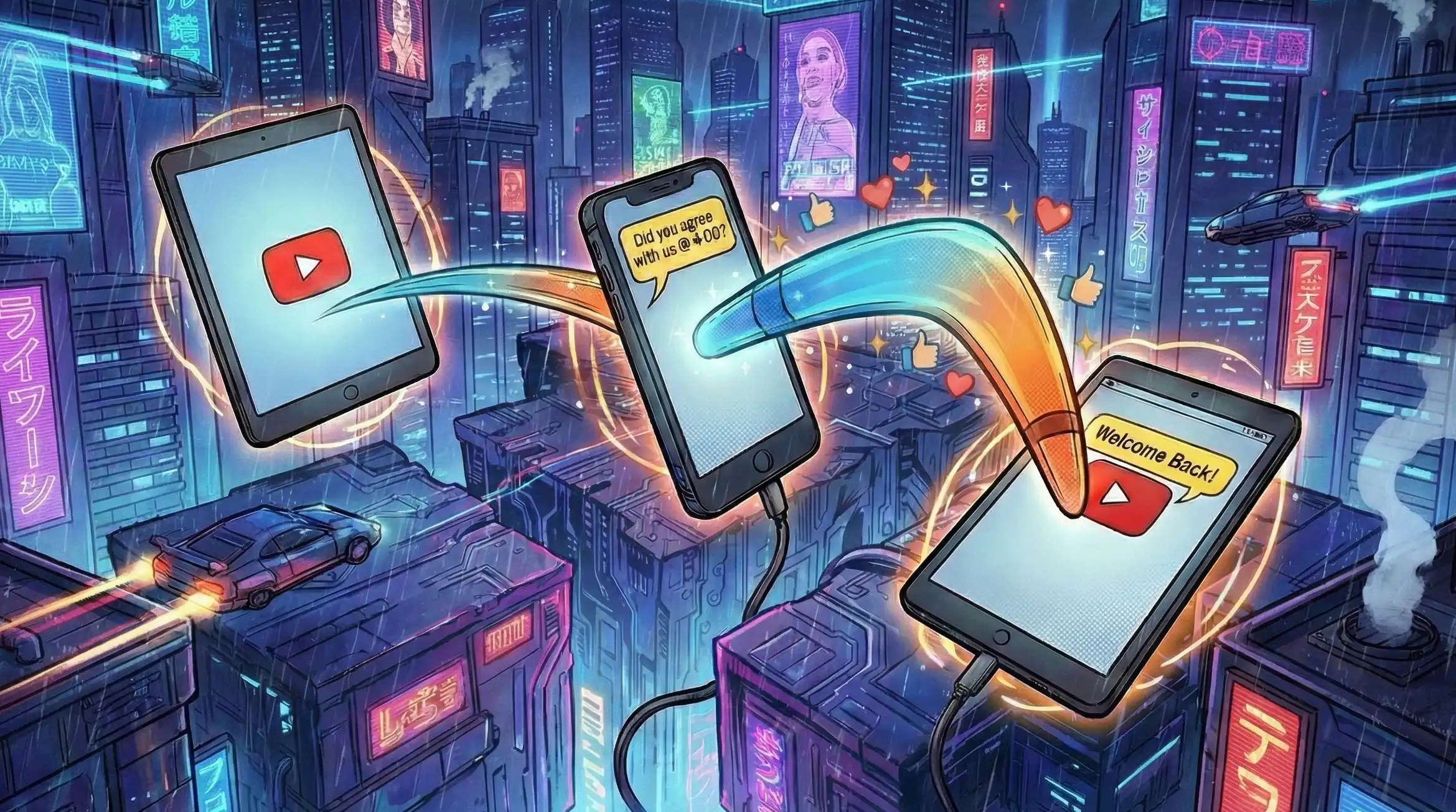
If you've been in the YouTube game for more than a minute, you are probably obsessed with Average View Duration (AVD). You check your retention graphs, agonize over the dips, and try to optimize every second to keep people watching.
But after working with hundreds of creators and analyzing millions of data points, we have realized that AVD is often a vanity metric.
High retention on a single video is great. But it doesn't solve the biggest problem facing mid-sized channels: Churn.
Most viewers are "tourists." They visit your channel, watch one video (maybe even all the way through), and then vanish. They don't subscribe, and even if they do, they don't return for the next one.
The metric that actually predicts channel longevity isn't AVD. It's Return Viewer Intent.
Specifically, the algorithm loves what we call a "Second Session." This is when a user stops watching, leaves the platform, and then, prompted by a thought about your content, opens the app again specifically to find you.
That action signals to YouTube that your channel isn't just content; it's a destination.
The Solution We Recommend: The "Re-Engagement Loop"
So, how do you force a Second Session? You can't just hope they remember you. You have to remind them.
For years, we advised our clients to implement a manual "Day 3 Check-In" strategy.
The concept is simple: The YouTube algorithm does its heavy lifting in the first 24–48 hours. After that, your video falls off the "New" shelf. If you want to revive it (and trigger that Second Session signal), you need to generate external traffic after the initial hype dies down.
Here is the manual workflow we taught:
- The Segmentation: Go into your email marketing tool (we're assuming you already have a newsletter - if you don't, well you need to start one yesterday).
- The Filter: Try to identify who clicked your "New Video" link on launch day.
- The Inversion: Create a segment of people who didn't click.
- The Nudge: 72 hours after upload, send a dedicated email to the non-openers with a different angle. Don't say "Watch my new video." Say, "We discussed [Specific Topic] at the 4-minute mark—did you agree?"
This drives users back to the platform days later, creating a "Return Session" that wakes the algorithm up.
Lessons from Countless Hours in the Trenches
We have advised multiple hundreds of clients and helped them implement their own re-engagement loops through email newsletters. And from everything we saw, we have been able to establish that this strategy work wonders for channel authority. Unfortunately, we also observed a few core issues, which eventually resulted in our clients burning out trying to maintain it.
First, there is the "Blind Spot." Most email tools tell you who clicked, but they don't tell you who watched. You might be sending a "Please watch this" reminder to a superfan who already watched the whole thing on their TV. That's annoying, and it causes unsubscribes.
Second, there is the timing nightmare. Creators are busy. Remembering to setup a re-engagement campaign in your newsletter manager exactly three days after an upload to manually segment a list and write a fresh email? It rarely happens consistently.
We built HypeKrew because we were tired of seeing good strategies fail due to execution fatigue. We wanted that "Day 3 Bump" without the spreadsheet headaches. So, we designed HypeKrew to track Watch Intent, not just clicks.
Because the system can see if a user watched 10% or 60% of your video, it allows for Smart Retargeting rules. You can tell the system: "If a user hasn't watched by Day 3, send them Reminder A. If they dropped off halfway, send them Reminder B." It turns the chaotic manual process of re-engagement into a set-and-forget background task, ensuring you're generating those "Second Sessions" on every single upload.
The Bottom Line
Whether you use HypeKrew, or do it by hand, you need to stop looking at your views as a single event.
A view is a relationship. And relationships require follow-up.
If you want to get Youtube's algorithm to work for you, start focusing on the "Day 3" metrics.
- Don't blow all your distribution ammo in the first hour.
- Save a specific angle or hook for a follow-up message.
- Reach out to the people who missed the first wave and invite them back.
If you can get a user to return to YouTube for you, the algorithm will make sure they stay for everyone else. And that is how you unlock rapid growth.